
Start your strategy now
Open Account
Exnova Strategy for Binary Options
Platform Access and the Trading Panel
Trading runs through the web platform and the mobile apps, available for both Android and iOS. Registration is straightforward — select your country, enter an email address and create a password. A live account can be funded from $10 using cards, e-wallets or bank transfer. Demo mode credits $10,000 in virtual funds for risk-free practice, though real positions only become available once you deposit.
Charts and tools are flexible: drag elements to rearrange them, switch indicators on, and move between demo and live mode with a single tap in the top panel. An economic calendar sits inside the dashboard. Language can be switched from the settings menu. The mobile version follows the same logic in a pocket format — the interface is built for touch, gestures work for zooming charts and scrolling, and opening a position behaves almost identically to the desktop site.
Before trading real money, it is worth spending time in the interface and testing each function in demo. The layout rewards familiarity, and mistakes made while learning where things are can be expensive later.
Opening and Managing Binary Positions
Start by selecting an asset: forex, stocks, commodities, indices or currencies. The platform shows the current quote alongside available expiry options. Short expiries begin at 5 seconds; longer ones can run for hours. Be aware that very fast trades are largely unpredictable.
From $1 upwards you enter the amount to stake on a position, with the payout displayed before you commit (typically 70–95%). Choose Higher if you expect the price to finish above the current point, Lower if you expect it to fall, then confirm the trade.
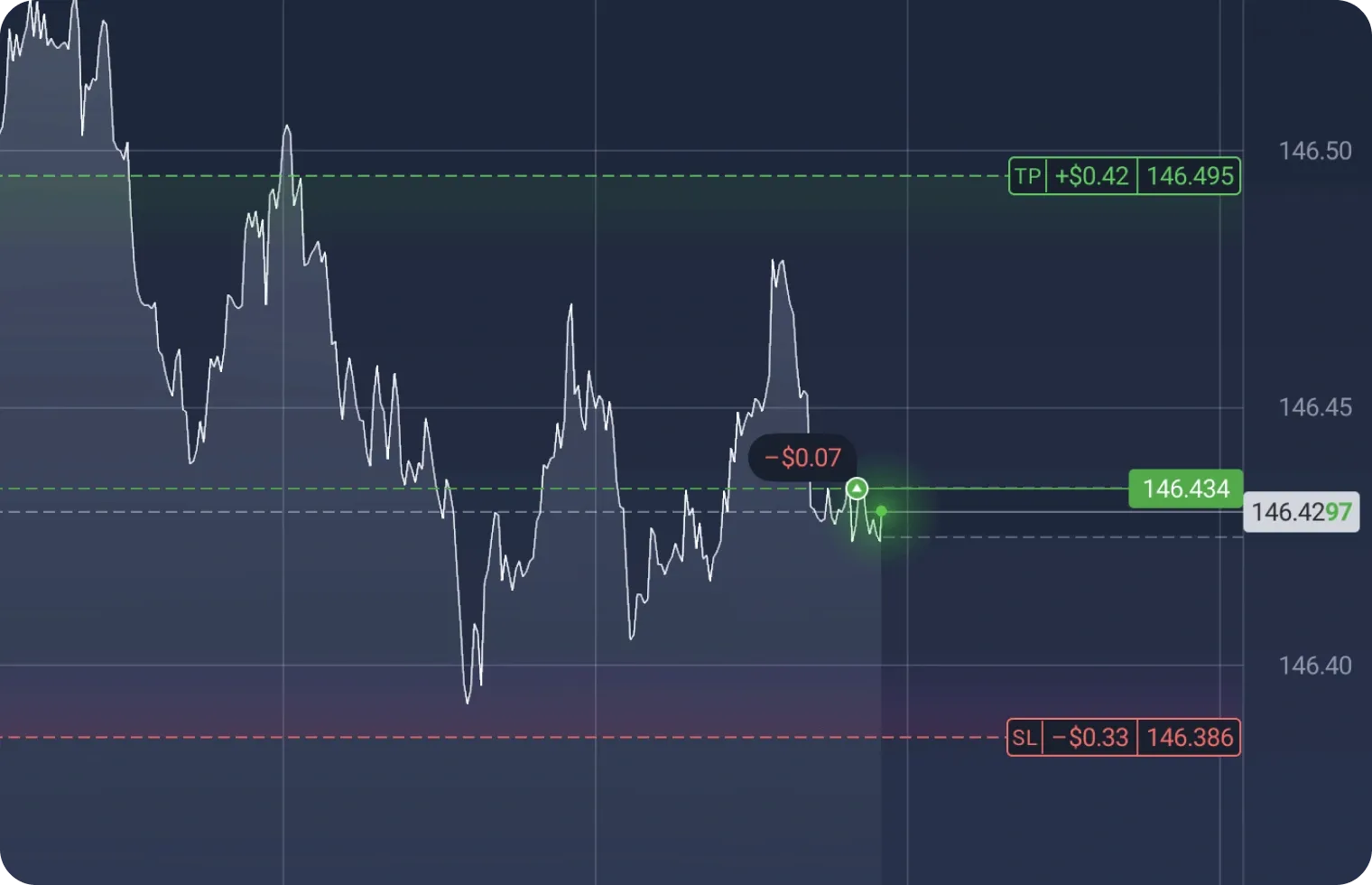
Once you are in a position you will see a countdown timer, your entry price, the live quote and the payout. Early exit is available through the Sell option, though payouts are reduced when closing before expiry. Completed trades move to your history automatically.
Choosing an Expiry Time
Expiry should match your analysis. The 5–60 second trades are mostly noise — there is rarely enough information in that window to act on. Standard binary trades of 5–15 minutes give technical analysis room to work. Beyond 30 minutes things settle further and trends hold better.
One habit worth building: if you spot a setup on a short chart, check the higher timeframe before entering. It filters out a good share of moves that look convincing but run against the larger trend.
Working With Technical Indicators
Indicators are added from the chart menu in a couple of clicks. The standard set is all there:
- Moving averages (20/50/200): track trend direction and give crossover signals when the fast and slow lines meet
- RSI (default 14): above 70 suggests overbought, below 30 oversold
- Bollinger Bands: price at the upper band acts as resistance, the lower band as support; wider bands mean higher volatility
- MACD: a positive histogram reads bullish, negative bearish, and crossovers hint at entry points
- Volume: not just supporting detail — spikes can warn of reversals or sudden breakouts
A few combinations make the reading easier. Moving averages plus MACD: when the short average crosses above the long one and the MACD histogram flips positive, that points upward. Mean reversion sometimes lines up too — price at the upper Bollinger band with RSI above 70 can be a case for trading against the move. Price pressed against the lower bands with RSI near 30 often works the same way in reverse.
| Indicator | Use | Typical setting |
|---|---|---|
| Moving average | Trend, crossovers | 20/50/200 |
| RSI | Overbought / oversold | 14 |
| Bollinger Bands | Volatility, extremes | 20, dev=2 |
| MACD | Momentum shifts | 12/26/9 |
| Volume | Confirming moves | n/a |
Matching Chart Timeframes
Indicators make more sense when your chart matches your expiry. One-minute and five-minute charts suit trades of 5–15 minutes. Longer positions respond better to higher timeframes — 15-minute or hourly — where noise drops away and trends hold more reliably. Checking the larger timeframe before pulling the trigger on a fast setup filters out a meaningful share of false signals.
Risk Management Basics
Position size matters more than entry accuracy. A common guideline is no more than 1–2% of your balance on a single position. On a $100 account that means staying near $2 per trade, even on the days when a setup looks certain.
Set a daily loss limit — somewhere around 5–10% of your funds. Once you hit it, stop for the day rather than trying to trade back to even. Three consecutive losses is a reasonable point to pause and reconsider what you are reading in the market.
Track your win rate over time rather than trade by trade. Because of how binary payouts work, roughly 60% is the level where the maths starts working in your favour. There is no reason to keep pushing a setup that is not performing — a three-month drawdown calls for a genuine review, not more volume.
Diversifying Across Assets
Staying on a single asset or pair indefinitely narrows your read on the market. Correlation creeps in too: two major forex pairs can move almost identically, while commodities follow their own drivers. A mix is usually healthier:
| Asset | Volatility | Expiry range | Main drivers |
|---|---|---|---|
| Forex | Moderate | 5 min – 1 hour | Economic news, data releases |
| Indices | Moderate–high | 15 min – 4 hours | Earnings, sentiment shifts |
| Commodities | High | 30 min – 4 hours | Global supply, policy |
| Crypto | Very high | 1 min – 1 hour | Sentiment, regulation |
Pick a handful of assets each morning — three to five is plenty — then wait for setups on those rather than scanning everything at once.
Why Demo Still Matters
Demo mode is not a formality to click past. Use it to test indicator combinations across dozens of setups rather than a handful. Around 50 practice positions is a reasonable minimum, recording your criteria and what actually happened each time.
Treat demo exactly as you would real money: no bending the rules on size, no quietly ignoring the trades that went badly. Moving to a live account is worth considering only after genuinely consistent results across 100 or more trades and at least two weeks of effort.
Planning Trading Sessions
Market availability depends on the asset:
- Forex: around the clock on weekdays
- Stocks: during exchange hours
- Commodities and crypto: separate windows
Work in Indian Standard Time when planning. The overlap between the European and American sessions — roughly 18:30–22:30 IST — is the most volatile stretch for forex, while the Asian session tends toward quieter, range-bound markets. That overlap suits traders in India well, since it falls in the evening rather than the middle of the working day.
Major news is worth avoiding entirely. Step back 15–30 minutes either side of significant economic releases — price swings during those windows are wide and largely unpredictable.
Tracking and Reviewing Results
A trading journal is not optional if you are serious about this. Record what you took, how, why, and what happened. Review it weekly rather than occasionally. Split your win rate by time of day, by asset and by indicator combination — patterns that are invisible in the aggregate often show up clearly once separated.
Go back through the losses specifically. Recurring themes tend to cluster around session timing or a particular asset class. Adjust your rules when you find one, but backtest the change in demo before applying it live. Month-on-month net profit against your starting deposit gives a far more realistic picture than watching individual trades. Aim for steady growth rather than outlier results.
Regulatory Position in India
Binary options are not regulated by SEBI, and platforms offering them to Indian residents operate from outside the country. Trading them may also raise questions under FEMA rules on cross-border transfers. As of 2026, jurisdictions including the UK and Australia maintain bans on retail binary options, and regulation continues to shift elsewhere. Most binary trading worldwide takes place outside a regulatory framework, and research consistently finds that the majority of retail traders lose money on very short-term contracts.
This matters practically, not just legally: without a regulator behind the platform, there is no external body to appeal to if something goes wrong with an account or a withdrawal.
Checking Balances and Withdrawing Funds
Your balance sits at the top of the dashboard and updates continuously. Transaction history is available at any time from account settings, down to dates, amounts and asset types.
Withdrawals follow a simple path: enter the amount, choose your method, and confirm. Funds return through the same channel used for the deposit wherever possible, which is standard anti-money-laundering practice rather than a platform restriction. Identity verification must be complete before a first withdrawal is released — uploading documents early, rather than at the moment you want to cash out, avoids the most common delay. Processing times vary by method, with e-wallets typically faster than card refunds or bank transfers.
FAQ
Is Exnova login secure?
Yes. Exnova uses encrypted connections to protect user data and account access.
Can I log in from my phone or tablet?
Yes. Exnova supports mobile browsers and trading apps.
Do demo and real accounts require separate logins?
No. Both accounts are available under one login.
What should I do if I can’t log in?
Use the password recovery option or try again after a few minutes.